This is a first-hand account of how the central progression systems in Infinite Loot-Loop are implemented and tested. The values below are taken from the version 4.0.2 Unity project, not reconstructed from a playthrough or copied from another guide. They may change in later balance updates, but they explain the reasoning behind the launch build.
A battle should be a decision, not background noise
Each Normal Mode run begins with 30 Adventure Points, or AP. A regular victory costs 1 AP. Losing a battle or choosing to run away costs 4 AP in Normal Mode and 6 AP in Hard Mode. A boss victory moves in the opposite direction: it refunds 3 AP and lets the expedition continue.
The important part is that success still has a cost. If every victory were free, the best strategy would be to remain in the safest zone until the character outleveled the rest of the route. Spending 1 AP turns that apparently safe choice into a trade: the player gains EXP, gold, a streak, and a chance at equipment, but gives up one of the encounters available before the run ends.
Bosses are deliberately different. The +3 AP reward makes a boss a source of momentum rather than only a gate. Reaching one early can extend a good expedition; challenging one too soon can consume several times the cost of a routine fight. That tension is why the map, encounter gauge, enemy catalog, and boss routes belong to the same system rather than four disconnected features.
The map controls the pace before combat begins
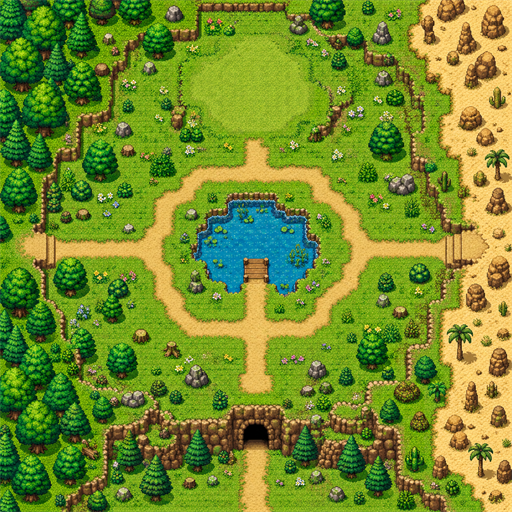
Movement fills an encounter gauge. The live default adds gauge as the character travels, and a stationary hold can intentionally search for a fight without forcing the player to walk in circles. At full gauge, an encounter is guaranteed; before that point, the chance rises with the amount already filled. Equipment can slow the gauge, which makes a navigation stat meaningful without removing encounters altogether.
This makes route planning physical. Crossing a map is not a free menu action: distance creates encounter pressure. The player can farm a useful zone, move toward a boss, or look for a safer route, but every choice changes when the next battle is likely to arrive. Boss arenas with no field enemies keep the gauge empty so the interface never promises an encounter that cannot occur.
A run can end without becoming wasted time
The game separates progress into two layers. Run-level EXP, temporary level growth, the current AP budget, and current-run gold create short-term momentum. Owned equipment, unlocked slots, completed achievements, defeated-boss records, character unlocks, and collection bonuses survive between attempts. A failed expedition can therefore lose momentum without erasing the reason it was worth playing.
Equipment copies connect the two layers. Each copy of a regular item contributes 1% of that item's base stats to the permanent collection total, so a completed ten-copy family banks 10% in total. Accessories complete at three copies on their own ladder: the first copy grants nothing, the second 2%, and the third 5% - accessories carry far larger base stats, so a smaller percentage still matters. The bonus is intentionally small per item so that equipped gear remains important, while a broad collection gradually lifts the floor of every future run.
The permanent total is recalculated from the actual item bank instead of trusting a number that has been repeatedly added to a save file. That matters when a balance curve changes: existing collections can be reevaluated from owned items without quietly duplicating or losing progress. Achievement bonuses are derived in the same spirit from the set of achievements the player has actually unlocked.
The original fresh start contained a progression deadlock
A clean save originally began with zero gold and no items. The weakest monster was stronger than a character using base attack alone, but gold was only awarded after a victory. That created a circular failure: the player needed a weapon to win, needed gold to buy a weapon, and needed a win to earn gold.
The fix was not to weaken the entire opening region or grant a large permanent boost. A new player now receives the Trainee Blade, deliberately the weakest weapon in the game, and it is automatically equipped. It is granted only when the player owns no weapon, so restarting a run cannot be used to stack free copies and inflate the permanent collection bonus.
This small case is representative of progression design. A spreadsheet can show that an average character eventually becomes strong enough; it cannot always reveal that the first step is impossible. The launch build therefore uses both simulation and clean-save playtesting. Simulations find pacing outliers across many runs, while device playtests expose interaction, readability, and state problems that averages hide.
The balance model uses the same assets as the game
The Normal Mode progression simulation runs 30 trials against the active boss, zone, enemy, item, and character assets. A simulated fresh player starts with the same 30 AP, base stats, six equipment slots, zero gold, and no collection. It buys affordable equipment, equips higher-value pieces, models duplicate drops and permanent collection bonuses, and chooses a farming zone only when its estimated chance of winning is at least 82%.
Boss attempts use a higher safety threshold in Normal Mode. This is not intended to dictate how a person must play. It supplies a repeatable baseline: if a conservative player suddenly needs far more runs to cross one map, or if a small gold change collapses the expected campaign length, the model identifies where to inspect the live data.
One useful lesson came from testing regional gold multipliers. A seemingly modest extra multiplier dramatically shortened modeled progression because gold buys equipment copies, copies add permanent stats, and those stats make later gold arrive faster. The effect compounded across runs. The change was reverted instead of being accepted merely because each individual percentage looked reasonable.
The website follows the same source-of-truth rule. Its catalogs are generated from the Unity data, while articles such as this one explain the design choices that raw values cannot communicate. The game-data methodology describes which fields are exported and how the published pages are checked.
A practical way to think about the next battle
- Name the reward you need. Fight for a level, an affordable upgrade, a specific drop, a streak, or a safer boss attempt—not simply because a monster is nearby.
- Compare the AP cost with the route ahead. A routine win costs 1 AP, while one bad matchup can cost four times as much in Normal Mode.
- Treat a boss as both risk and fuel. A successful challenge opens progress and returns 3 AP, but an early loss can erase the value of several safe wins.
- Value new items even when they are not immediately equipped. The collection system means the first copy adds permanent progress, and later copies improve both the item and its completed collection value.
- End a run with information. If a route failed, check whether the missing piece was survival, damage, encounter pacing, or AP efficiency. Each answer points to a different next goal.